
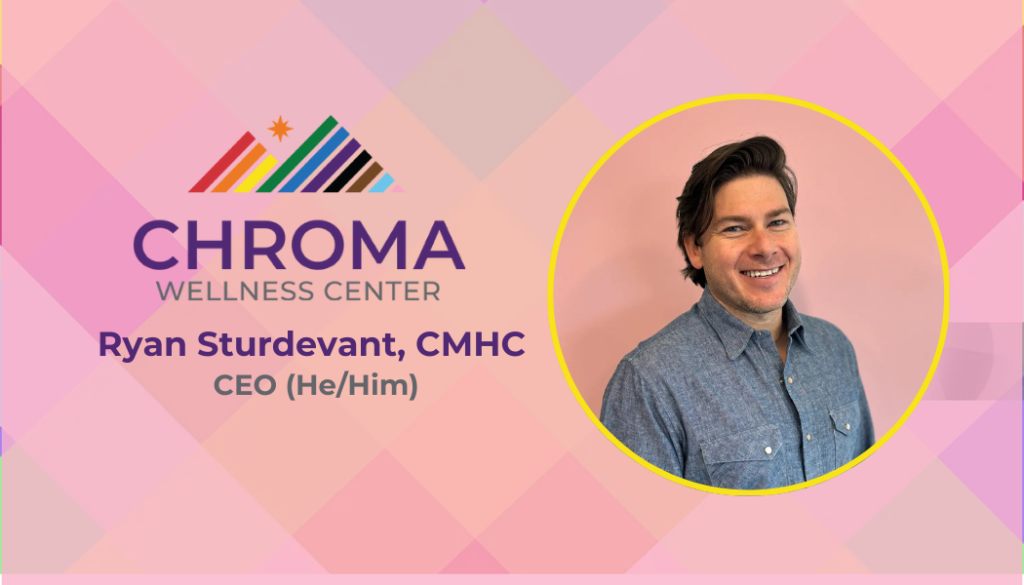
When people first meet Ryan Sturdevant, they often notice two things immediately: his clarity of purpose and the grounded, lived experience behind it. Ryan isn’t building Chroma Wellness because it was a clever business idea or a gap in the market. He’s building it because he has lived the gaps. He has seen them, worked within them, and, far too often, watched people fall through them.
Chroma Wellness exists because Ryan believes queer and trans people deserve far more than what traditional behavioral health models have offered. And his story explains exactly why. As an LGBTQIA+ leader creating a fully LGBTQIA+ mental health treatment program, his mission is rooted in lived experience and deep clinical understanding.
Where the Work Began
Seventeen years ago, Ryan started where many people in this field do: on the front lines. As a behavioral health technician finishing his Substance Use Disorder Counseling training, he spent his days (and nights) helping clients navigate withdrawal, trauma, fear, hope, and the fragile beginnings of recovery. He saw, up close, how much courage it takes to heal and how much it matters to feel safe in the spaces meant to help you.
It didn’t take long for Ryan to see a familiar pattern: LGBTQIA+ clients often walked into treatment silently carrying identity-based shame, fear, or guardedness, unsure if they would be fully accepted. Many waited weeks before discussing the deepest, identity-rooted parts of their lives, not because they weren’t ready, but because the environment wasn’t. Ryan recognized the connection between safety and healing, especially in work related to trauma and PTSD.
This was the moment his clinical instincts sharpened:
Safety isn’t something you tell clients they have. It’s something you build around them.
He went on to complete his master’s degree in Clinical Mental Health Counseling, eventually treating clients directly and stepping into leadership roles ranging from therapist to Clinical Director. Those years of clinical depth became the backbone of how he leads today.
A Second View of the Industry: Business Development & National Outreach
About seven years into his clinical work, Ryan transitioned into business development and national outreach, a move that would give him a 30,000-foot view of an industry he already knew deeply from the ground.
This is where his frustration and his vision began to take shape.
He traveled the country. He visited programs. He trained teams. He built national referral networks. And he repeatedly saw the same thing:
Programs claiming LGBTQIA+ competence were, in reality, offering a single weekly group, a rainbow sticker in the lobby, or a line on the website that said “all are welcome.”
Meanwhile, queer and trans clients were discharging without ever addressing core identity wounds, such as untreated anxiety or depression, because they never felt safe enough to speak honestly.
In one facility, Ryan stepped in to run a group himself because clients had gone weeks without any space specifically designed for them. What followed were some of the most raw, honest, painful, and beautiful conversations he had witnessed in treatment.
That experience stayed with him.
It is the moment he now looks back on and says: “This is why I have to build something different.”
The Spark That Became Chroma
Chroma Wellness wasn’t born from a business plan, it was born from a sense of responsibility.
As a gay man in long-term recovery, Ryan understands what it feels like to walk into a space and wonder, “Am I safe here? Can I be fully myself?” That question shapes nearly every experience queer and trans people have in medical and behavioral health environments.
And yet, most programs still operate with models designed with straight, cisgender clients in mind.
So Ryan asked a different question: “What would a treatment center look like if it were designed for LGBTQIA+ people first, not as an afterthought?”
The answer became Chroma Wellness Center.
A place where:
- Identity isn’t something clients have to explain, it’s the foundation of the program.
Safety isn’t conditional, it’s architected into the environment. - Queer and trans people aren’t one small subgroup, they are the heart of the community.
- Treatment isn’t adjusted to “accommodate” LGBTQIA+ clients, it is built around them from day one.
And the name Chroma?
Ryan discovered it during a long naming process. Three iterations, hundreds of ideas, thousands of second guesses, and when he learned that “chroma” means intensity of color, something clicked.
“So many people come to treatment feeling dulled, dimmed, disconnected from their own color,” he says. “My goal is that they leave Chroma with that vibrancy restored.”
Leading With Ethics, Not Ego
After nearly a decade working for large behavioral health companies, Ryan made a promise to himself:
He would never operate a program where profit comes before people.
Chroma is built differently.
Ryan is intentional about:
- Reinvesting in clinical care
- Hiring clinicians with lived experience
- Expanding services like psychiatry and neuropsych testing
- Creating housing that feels dignified, not institutional
- Partnering with organizations like Envision: You and Judith Landau’s ARISE Network
- Designing programming reflective of real queer and trans experiences
He doesn’t compromise on ethics.
He doesn’t sugarcoat clinical realities.
He doesn’t tolerate rainbow-washing.
He wants straight people to look at Chroma and say, “Why can’t I come here?” , not because he wants to serve everyone, but because he wants to prove what high-quality, values-driven care can look like when it’s done right.
This includes offering a LGBTQIA+ intensive outpatient program and a fully integrated LGBTQIA+ addiction treatment center designed around the realities of queer and trans lives.
Building a Hub for Queer Healing in Denver
Ryan’s long-term vision goes beyond one program. He wants Denver to become a national safe harbor, a place where LGBTQIA+ people from around the country can access:
- Affirming mental health treatment
- Culturally responsive care
- Expert-led trauma therapy
- Identity-focused recovery support
- Community connection
- A space where being queer or trans is not something to navigate around, but something to honor
He knows that for many living in states with harmful legislation or limited local resources, finding safety is half the battle.
Chroma is meant to be that landing place.
Where the Story Goes Next
Ryan often describes Chroma as his “baby”, something he dreamed about for years, doubted at times, carried through personal challenges, and finally committed to building despite the uncertainty.
But more than anything, Chroma is a promise.
A promise that queer and trans people will not have to fight for legitimacy in their own healing spaces.
A promise that treatment can be ethical, affirming, and clinically excellent at the same time.
A promise that the people who have been told, explicitly or implicitly, that their identities are problems to be fixed will instead be told:
“You are whole. You are worthy. And you deserve a place built just for you.”
That is why Ryan started Chroma.
And that is why this work matters.