
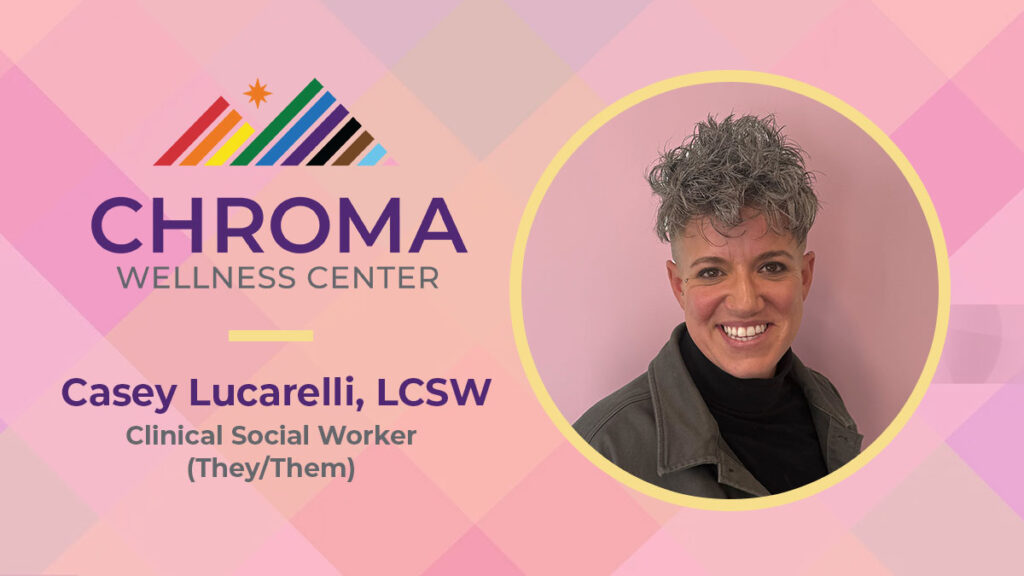
For many LGBTQIA+ individuals, the journey into mental health and addiction treatment is shaped not only by symptoms, but by years of oppression, mislabeling, and emotional survival. In a recent conversation with Chroma Wellness clinician Casey Lucarelli, a central theme emerged again and again: healing begins when people are seen as human first—beyond diagnosis, trauma, or identity labels.
That need for safety is increasingly urgent. According to a January 2026 study by the Human Rights Campaign, nearly 50% of LGBTQ+ adults report being less out in at least one area of their lives—including workplaces, healthcare settings, and public spaces—compared to a year ago. For many, concealment has once again become a strategy for survival.
Casey has spent over 15 years working with individuals and couples navigating trauma, addiction, and identity development, with a deep commitment to queer and trans communities.
That commitment, Casey shared, grew out of lived experience with repression and cultural messaging that taught many LGBTQIA+ people to push emotions down just to get through the day. “There’s a strong passion I have for meeting individuals where they’re at,” Casey explained, “and not making their trauma history mean something about who they are.”
A recurring question Casey hears from queer clients is whether their identity is caused by trauma. Rather than reinforcing that narrative, Casey helps clients disentangle experience from identity. “It’s these different experiences that one goes through,” Casey said, “and not making it mean something about them or who they are.” Trauma may shape a story—but it does not define a person.
At the core of Casey’s clinical approach is relationship. Drawing from parts work, mindfulness, and humanistic care, Casey emphasizes presence over performance. “The client is the expert of their own life,” Casey shared. “How can I walk beside them rather than dragging them or them pulling me?” In this model, therapy becomes a partnership—one rooted in curiosity, compassion, and shared humanity.
“WHEN THERE’S SAFETY PRESENT, THAT’S WHERE HEALING BEGINS. WITHOUT THAT, I DON’T BELIEVE ANY MODALITY WILL STICK.”
THE CLIENT IS THE EXPERT OF THEIR OWN LIFE,” … “HOW CAN I WALK BESIDE THEM RATHER THAN DRAGGING THEM OR THEM PULLING ME?”
This relational safety is especially critical in a healthcare landscape that has become more difficult to navigate. The same HRC report found that 66% of transgender and nonbinary adults experienced difficulty accessing healthcare due to administration policies, and many reported worsening health as a result. When care itself feels unsafe or inaccessible, therapy must become a rare space where people can exhale.
Casey also spoke about how queer clients often mask pain—sometimes through over-engagement with external stressors or constant vigilance. “There’s truth in what’s happening in the world,” Casey noted, “but what’s underneath that too?” Healing involves helping clients recognize when engagement becomes overwhelming and when boundaries are needed to protect their nervous system.
Ultimately, Casey’s work at Chroma Wellness centers on helping clients reclaim parts of themselves that were shamed, silenced, or hidden. Whether through self-compassion groups, identity exploration, or relational repair, the goal remains the same: safety. As Casey put it, “When there’s safety present, that’s where healing begins. Without that, I don’t believe any modality will stick.”
At Chroma Wellness, this philosophy is not abstract—it is practiced daily. And for many clients, it marks the first time they are truly able to be themselves.