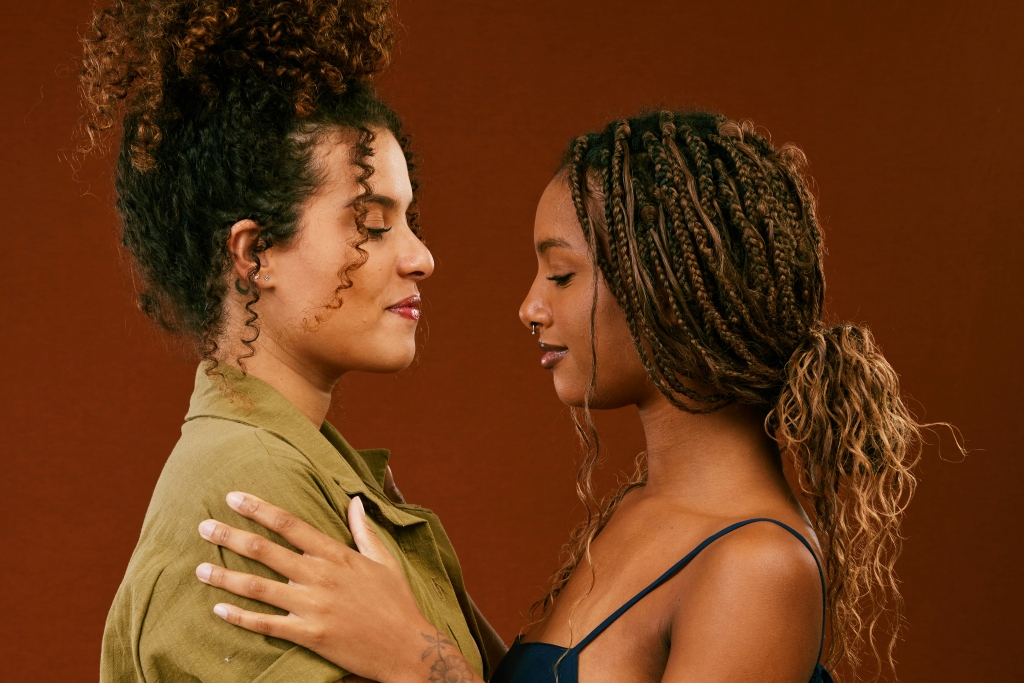
Demisexual describes someone who only feels sexual attraction after forming a strong emotional bond with a person. Without that bond, the attraction simply isn’t there, no matter how conventionally attractive someone might be. [1]
The term confuses people at first, partly because it sounds like a preference rather than an orientation, and partly because many people assume everyone works this way. Neither is quite true, and the difference matters for how people understand themselves.
This article walks through what demisexuality means, how it differs from asexuality, and why so many people spend years feeling “off” before they’re able to name this experience.
If questions about identity, relationships, or attraction are tangled up with anxiety, depression, or shame for yourself or a love done, LGBTQIA+ mental health treatment can help.
Key Takeaways (TL;DR)
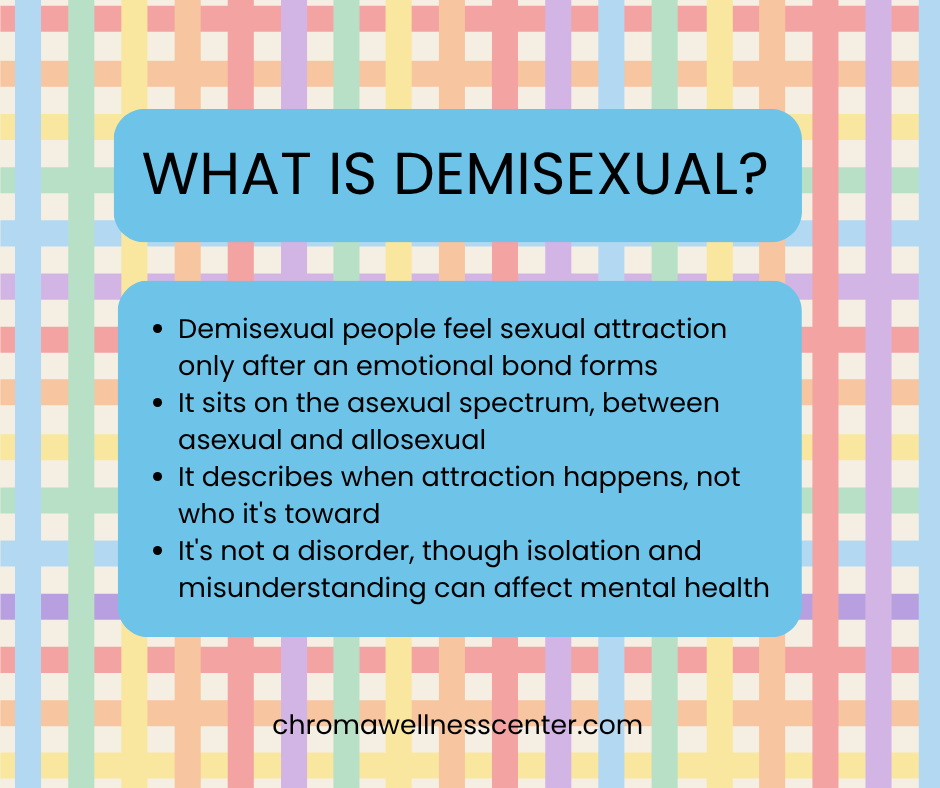
- Demisexual people experience sexual attraction only after an emotional connection has formed, not from appearance or first impressions.
- Demisexuality is usually placed on the asexual (ace) spectrum, between asexual and allosexual, but it is its own distinct experience.
- It describes when attraction happens, not who it happens with, so a person can be demisexual and also gay, straight, bisexual, or pansexual.
- Demisexuality is not a disorder, but the isolation and misunderstanding that often come with it can affect mental health, and affirming support helps.

What Does Demisexual Actually Mean?
Demisexuality is a sexual orientation in which sexual attraction develops only after a strong emotional bond has formed. [1] The bond comes first. Attraction may or may not follow from it.
A helpful way to think about this is the difference between primary and secondary attraction. Primary attraction is the kind that shows up quickly, based on how someone looks or carries themselves. Secondary attraction builds over time out of emotional closeness. Most people experience both. Demisexual people experience little or no primary attraction, so secondary attraction is the only door in. [4]
Demisexuality isn’t a decision to wait for the right person. It also isn’t the same as disliking sex. Once a bond exists, plenty of demisexual people want regular sexual intimacy. What they can’t do is feel drawn to someone they don’t know yet. [1]
Isn’t That Just How Most People Work?
This is the most common question, and the honest answer is no. Most people can look at a stranger, a celebrity, or someone across a room and feel a pull toward them, even if they never act on it. Choosing to wait before having sex is a decision about behavior. Demisexuality is about whether the attraction exists at all. [1]
It also helps to separate admiring someone from wanting them. Finding someone beautiful is not the same as wanting them. For most people, some degree of physical pull shows up within seconds of meeting someone, and for demisexual people it just isn’t there. [4] Many demisexual people describe their early crushes as “I admire this person and wish I could be more like them,” and only realize later that friends meant something much more physical. [4]
If you’ve read a definition of demisexuality and thought, “wait, doesn’t everyone feel this way?”, that reaction itself is often the first clue.
How Is Demisexuality Different From Asexuality?
Both sit on what’s often called the ace spectrum, which runs from asexual (experiencing little or no sexual attraction) to allosexual (experiencing it regularly). Demisexuality lives in the gray area between the two, and some people describe it as a specific form of gray-asexuality. [2]
The dividing line is the bond. Asexual people typically don’t experience sexual attraction even when a deep emotional connection is present. Demisexual people can, once that connection exists. [1] That difference is why a growing number of researchers treat demisexuality as its own orientation rather than a subtype of asexuality. [3]
It isn’t a rare experience within ace communities. In the 2019 Ace Community Survey, 9.5% of 10,184 respondents identified as demisexual. [3, 5]
Can You Be Demisexual and Gay, Straight, Bi, or Pan?
Yes. Demisexuality describes the conditions under which attraction happens. It says nothing about the gender of the people you’re attracted to. [4]
Someone might be a demisexual lesbian, a straight demisexual, or pansexual and demisexual at the same time. Many people also use separate labels for romantic orientation, such as homoromantic, biromantic, or panromantic demisexual, since romantic and sexual attraction don’t always point in the same direction. [2, 4]
This layering can feel like a lot of vocabulary, and no one is required to use all of it. The labels exist because people wanted more precise ways to describe experiences that a single word couldn’t hold.
What Does Being Demisexual Often Look Like?
There’s no test for demisexuality, and the only person who gets to decide whether the word fits is you. People who identify as demisexual do describe a familiar set of experiences, though.
- Crushes on friends, often after knowing them for a long time [4]
- No real interest in celebrities or strangers, even ones everyone else finds attractive [1]
- Confusing “I admire this person” with “I want this person” [4]
- Feeling like a late bloomer, or wondering if something was wrong [4]
- Going along with hookups or relationships to fit in, then feeling disconnected [4]
- Not finding a word for the experience until well into adulthood [4]
Some demisexual people form bonds almost immediately. Others need months or years. [1] Both are demisexual.
What Misconceptions Do Demisexual People Run Into?
Because demisexuality isn’t visible from the outside, people who identify this way spend a lot of energy explaining themselves. The responses they get fall into predictable patterns. “You just haven’t met the right person.” “You’re a late bloomer.” “That’s just having standards.” “Were you hurt as a kid?” “Is it a hormone thing?” [4]
Some pushback also comes from inside LGBTQIA+ spaces, where ace identities are occasionally dismissed as a lack of sexuality instead of being recognized as a form of it. That double layer of not fitting in can leave people feeling isolated in both mainstream and queer communities. [4]
This matters for mental health. In one study across sexual and gender minority groups, the demisexual group reported higher levels of anxiety and depression than any other group in the sample. The demisexual sample was small (55 people), so it’s a signal rather than a settled finding, but it points to real strain. [3, 6]
When Is It Worth Talking to an Affirming Provider?
Demisexuality is not a disorder, and it doesn’t need to be treated or fixed. The concern runs the other way. Because demisexuality isn’t mentioned in the DSM-5, it can be misread in clinical settings as a sexual desire disorder, which is exactly the kind of misdiagnosis affirming clinicians are trained to rule out. [3]
Someone might still want support because of shame about not being “normal.” Or strain in a relationship where partners have different patterns of attraction. Or anxiety and depression that got tangled up with years of feeling different. [3, 4] An affirming provider starts from the position that your orientation is valid and works from there.
If any of that sounds familiar, it’s okay to reach out when it feels right, and to take your time getting there.
How Chroma Wellness Can Help
Chroma Wellness Center in Denver was built for LGBTQIA+ adults, including people whose identities are often misunderstood even within queer spaces.
Our LGBTQIA+ Partial Hospitalization Program (PHP) and Intensive Outpatient Program (IOP) treat anxiety, depression, trauma, and co-occurring substance use with clinicians who understand the whole spectrum of sexuality and gender, alongside affirming housing for those traveling from out of state or needing a higher level of support.
Call 720-410-5569 when you’re ready, or let our compassionate admissions team verify your insurance to get started.
FAQs
What does "berrysexual" mean?
Berrisexual (sometimes spelled berrysexual) is a community-coined microlabel, not a clinical term. According to LGBTQIA+ community wikis, it describes attraction to all genders with a strong preference for feminine and androgynous people and only rare attraction to men. [7] It’s unrelated to demisexuality, which is about when attraction develops rather than who it’s toward.
Can demisexuals be straight?
Yes. Demisexuality describes the emotional bond needed before attraction can happen, not the gender of the person. A straight demisexual is attracted to a different gender, but only after a close connection forms. [4]
What is the difference between pansexual and demisexual?
Pansexual describes attraction to people regardless of gender. Demisexual describes attraction that only develops after an emotional bond, and the two answer different questions. A person can be both. [4]
How do I know if I am demisexual?
There is no test. Many people recognize themselves in the pattern of only feeling attraction toward people they’ve grown close to, and in the sense that their experience never matched what friends described. [4] If the label helps you understand yourself, that’s enough reason to use it.
Is demisexual part of the LGBTQIA+ community?
Demisexuality is generally considered part of the asexual spectrum, which falls under the “A” in LGBTQIA+. Some people debate this, and that debate is one reason demisexual people can feel out of place in queer spaces. [4]
Do demisexual people enjoy sex?
Many do. Demisexuality is about how attraction forms, not about disliking sex. Once a bond exists, some demisexual people want regular sexual intimacy, while others want it less often or not at all. [1]
Sources
[1] Abdullah, J. R. (2020). Demisexuality. In The Sage encyclopedia of multicultural counseling, social justice, and advocacy. Sage.
[2] Davidson, J. D., & Neilson, E. C. (2023). Demisexual and demiromantic. In A. D. Lykins (Ed.), Encyclopedia of sexuality and gender. Springer.
[3] Fiorini, M. S. (2022). Asexuality and demisexuality: Clinical implications of sexual identity [Doctoral paper, University of Denver]. Digital Commons @ DU.
[4] Barton, A. (2019). Demisexuality as a contested sexuality. IU South Bend New Views on Gender, 19, 25–35.
[5] Weis, R., Hermann, L., Bauer, C., Miller, T. L., Baba, A., van der Biezen, T., Campos, A., Smiga, J. A., Tomaskovic-Moore, S., Trieu, T. H., Walfrand, A., & Ziebert, J. (2021). The 2019 asexual community survey summary report. Asexual Community Survey Team.
[6] Borgogna, N. C., McDermott, R. C., Aita, S. L., & Kridel, M. M. (2019). Anxiety and depression across gender and sexual minorities: Implications for transgender, gender nonconforming, pansexual, demisexual, asexual, queer, and questioning individuals. Psychology of Sexual Orientation and Gender Diversity, 6(1), 54–63.
[7] LGBTQIA+ Wiki. (2026). Berrisexual. Community-maintained entry.