Asexuality is a term to describe the experience of having little to no sexual attraction to others. It’s a sexual orientation—not a medical condition, phase, or something caused by trauma.
According to research published in CMAJ, somewhere between 0.4% and 4% of people identify as asexual, though many researchers believe the actual number is higher since asexuality often goes unreported or unrecognized.
If you’re trying to understand your own experience or someone you care about, you’re not alone. Chroma Wellness offers LGBTQIA+-affirming mental health care for anyone navigating identity, relationships, or the more complicated feelings that can come with figuring out who you are.
Key Takeaways (TL;DR)
- Asexuality means experiencing little or no sexual attraction to others; it exists on a spectrum.
- Asexuality is a sexual orientation, not a disorder, phase, or problem.
- Asexual people can still fall in love, want relationships, and enjoy physical affection like kissing or cuddling.
- Sexual attraction and romantic attraction are different things. Someone can be asexual and still romantically interested in others.
- There’s no test for asexuality. It’s something people usually come to understand by paying attention to their own patterns over time.
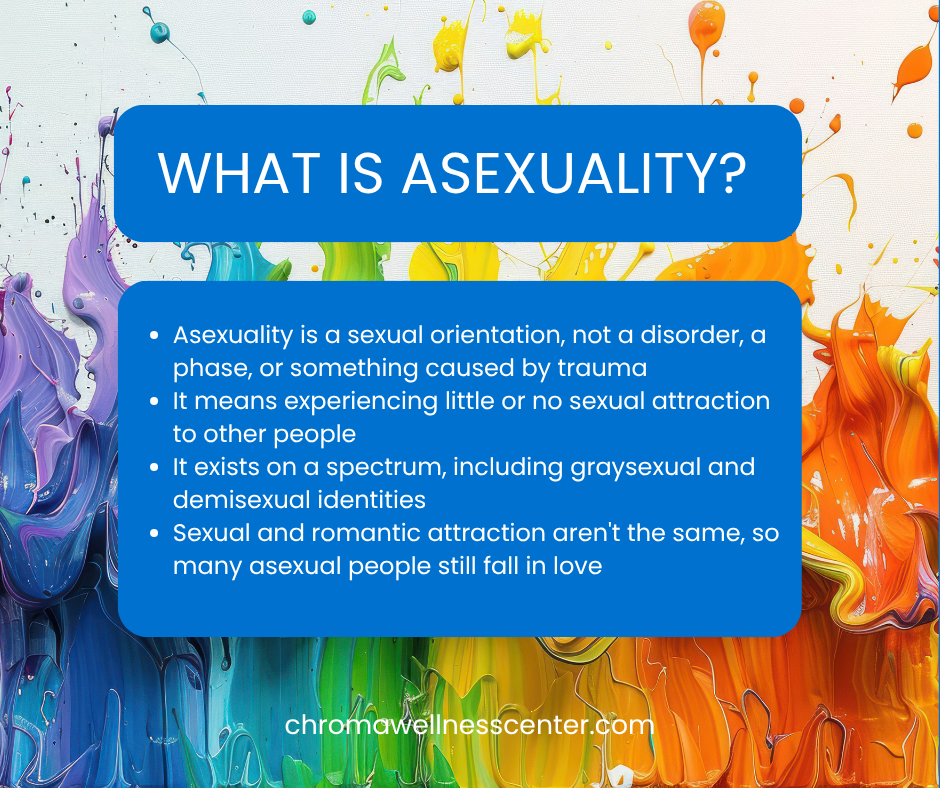

What Is Asexuality?
At its core, asexuality is a term used to describe the experience of having no sexual attraction to other people, or experiencing it so rarely that it doesn’t feel like a notable part of your life. This is different from having a low sex drive or difficulty with arousal, which are related to medical or situational issues.
Researchers who study human sexuality describe asexuality as its own sexual orientation, distinct from disorders of sexual desire [1]. For example, someone can be asexual, and their body may still respond to physical touch. An asexual individual may still masturbate, or still have sex for reasons unrelated to attraction, like wanting closeness with a partner. Asexuality specifically describes sexual attraction, and isn’t at all related to physical capability.
Does Asexuality Exist on a Spectrum?
Yes. Asexuality isn’t all-or-nothing, and many people fall somewhere along what’s often called the ace spectrum.
Graysexual (or gray-asexual) describes those who experience sexual attraction rarely or only under specific circumstances. Demisexual describes people who only experience sexual attraction after they’ve formed strong emotional bonds with someone [2].
You don’t have to feel a complete absence of attraction to identify as asexual or ace. Perhaps the traditional definition of asexual doesn’t quite fit, but you still relate to the general experience of low or inconsistent sexual attraction.
This experience is common and it’s part of why asexuality can take time to recognize, whether you’re looking at it in yourself or someone else.
Asexual vs. Aromantic: What’s the Difference?
Sexual attraction and romantic attraction are two different things, even though they’re often assumed to go together.
Asexuality describes a lack of sexual attraction, while aromanticism describes a lack of romantic attraction—or ck of interest in relationships built around romantic connection.
Someone can be asexual and still be romantically interested in people. Someone can also be both asexual and aromantic.
Research on asexual identity has found that people who do experience romantic attraction often seek emotional intimacy and closeness in relationships, even without sexual attraction driving that desire for connection [3].
What Feelings Come Up When People Come Out Later in Life?
Mixed emotions are common during the coming out process. Some people describe grief over years spent living inauthentically, combined with real relief at finally feeling like themselves [3]. The grief doesn’t cancel out the relief. Both can exist at the same time.
Research on LGBTQIA+ adults who come out later in life hasn’t found that this group fares worse in mental or physical health than those who come out earlier. What matters more than timing is support—things like community connection and affirming, accepting relationships [2].
If you’re wondering about yourself or even a partner or loved one, this difference can matter. It can be helpful to understand that an asexual partner not wanting sex doesn’t mean they don’t love you or desire closeness.
Common Misconceptions About Asexuality
One common misconception about asexuality is that it’s a result of trauma, low self-esteem, or fear of intimacy. Research simply doesn’t back this up. Asexuality is a recognized sexual orientation that stands on it’s own; it’s not simply a symptom of other challenges [1].
Another misconception about asexuality is that it’s the same thing as celibacy. While celibacy is a choice to abstain from sex, asexuality isn’t a decision. It’s an orientation where sexual attraction is either present or absent.
Incidentally, asexual people report higher rates of anxiety and depression than people of other sexual orientations, and often face barriers to affirming health care because of misunderstanding and pathologization of their identity [4]. This highlights a gap in how health care and society as a whole understand asexuality. There’s nothing wrong with being asexual, and it’s not something that needs to be fixed or cured.

How Chroma Wellness Can Help
Chroma Wellness offers LGBTQIA+-affirming mental health, substance use, and trauma treatment in Denver, with supportive housing available for clients who need a more immersive level of support, including those coming from outside the Denver area.
Whether asexuality is one part of a bigger picture you’re working through, like anxiety, depression, or relationship stress, our team is built specifically by and for the LGBTQIA+ community.
Call 720-410-5569 when you’re ready, or verify your insurance to take the next step.
FAQs
What makes a person asexual?
There’s no single cause for asexuality. It’s considered a natural variation in sexual orientation, not something caused by a traumatic event or other experience.
Do asexuals fall in love?
Yes. Many asexual people experience romantic attraction and desire close relationships, even though they may not feel sexual attraction toward their partner.
How can you know if you're asexual?
There’s no test or quiz you can take to determine f you’re asexual. Most people recognize this internally by noticing consistent patterns of little or no sexual attraction to people over time. Sometimes part of this process involves comparing their experience to peers as well.
What is the grief associated with coming out late in life?
This grief often centers on years spent not living authentically, on relationships shaped by hiding and concealment, or simply on time that feels lost. It sometimes shows up alongside relief, not instead of it.
Is asexuality the same as celibacy?
No. Celibacy is a choice to abstain from sex. Asexuality, on the other hand, is about the absence of sexual attraction itself, regardless of whether someone chooses to have sex.
Sources
Brotto, L. A., & Milani, S. (2022). Asexuality: When sexual attraction is lacking. In D. P. VanderLaan & W. I. Wong (Eds.), Gender and sexuality development (pp. 567–587). Springer.
Hille, J. J. (2023). Beyond sex: A review of recent literature on asexuality. Current Opinion in Psychology, 49, Article 101516.
Kelleher, S., & Murphy, M. (2022). Asexual identity development and internalisation: A thematic analysis. Sexual and Relationship Therapy, 39(2), 1–29.
Ross, L. E. (2023). Asexuality. CMAJ, 195(47), E1627.