Feeling anxious about coming out is common, and it doesn’t mean something is wrong with you. Anxiety usually shows up because you’re anticipating how someone might react, rather than because coming out itself is dangerous.
Techniques like cognitive restructuring and exposure-based practice, both core tools in cognitive behavioral therapy (CBT), can help you manage anxiety in the moment and over time [1]. For some people, anxiety around coming out is layered on top of other challenges, and structured LGBTQIA+ mental health support can be helpful.
This guide walks through what actually helps, why coming out tends to feel this anxiety-provoking in the first place, and when it might be worth reaching out for more support.
Key Takeaways (TL;DR)
- Anxiety about coming out is a normal response, not a sign that something is wrong with you.
- Anticipating reactions is what tends to drive anxiety more than coming out itself.
- CBT techniques like cognitive restructuring, exposure, and grounding exercises can help reduce anxiety in the moment and over time.
- Who you come out to matters. Acceptance from friends or chosen family is consistently one of the most protective factors for mental health.
- Anxiety that persists, worsens, or interferes with daily life is worth seeking support for.

What Actually Helps Reduce Anxiety About Coming Out?
A few CBT-based strategies can help before and during the conversation. Cognitive restructuring involves noticing catastrophic thoughts (“this will destroy the relationship”) and testing them against more realistic alternatives [1].
Behavioral experiments work a little differently: instead of assuming you already know how someone will react, you get real information by starting the conversation. That doesn’t mean the outcome will be good. For some people, a feared reaction is realistic, not just anxious thinking, and choosing who to tell first, and when, matters. Starting with someone you trust still gives you real information either way. If it goes well, that’s meaningful evidence the fear didn’t hold up here. If it goes badly, that’s a real loss worth taking seriously, not a sign you did something wrong, and it doesn’t mean every other relationship will go the same way [1].
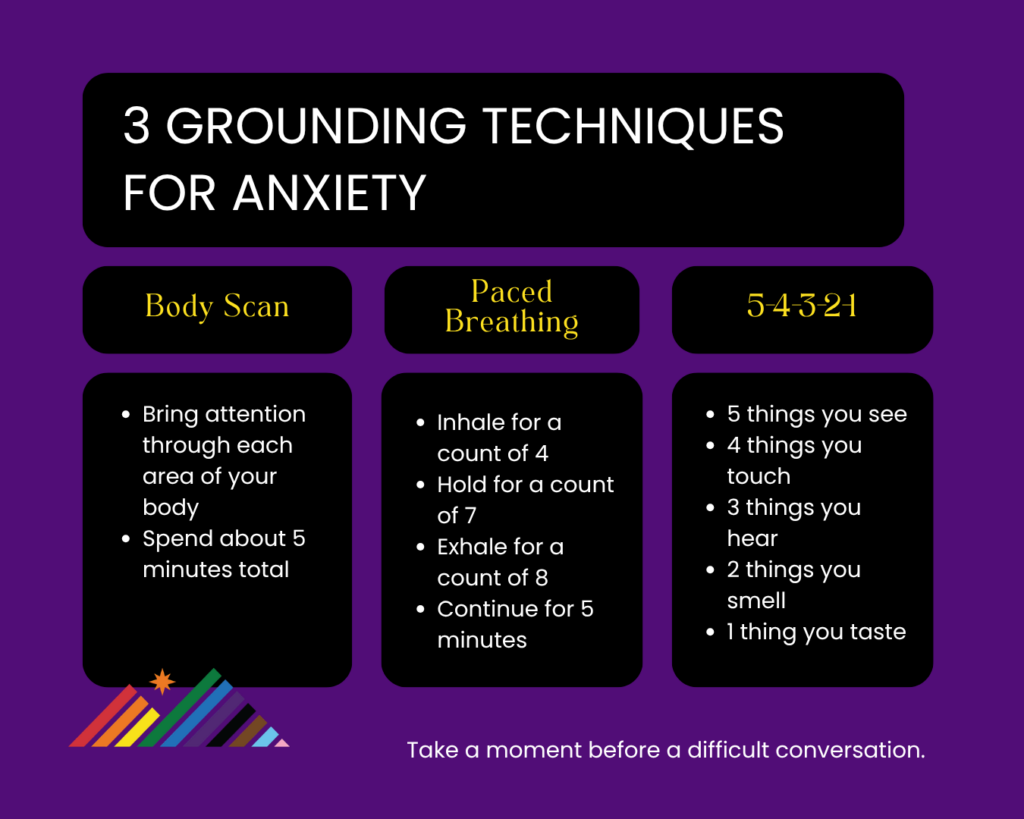
For in-the-moment anxiety, grounding techniques can help calm your body’s stress response. The next section walks through three ground exercises you can try right now.
What Grounding Techniques Can Help Right Before or During a Hard Conversation?
Grounding techniques work by shifting your attention to the present moment, which can interrupt a spiraling, anxious thought pattern. A study of clinicians tested three techniques and found each produced measurable decreases in physiological stress markers, with the body scan showing the most consistent effect across every measure studied [6]. Here’s how to do each one.
Body scan
- Sit or lie down somewhere reasonably quiet.
- Bring your attention to different areas of your body, one at a time, noticing whatever sensations or tension are there.
- Move through your body at whatever pace feels natural, there’s no required order.
- Spend about 5 minutes total.
Paced breathing
- Inhale slowly through your nose for a count of 4.
- Hold that breath for a count of 7.
- Exhale slowly through your mouth for a count of 8.
- Continue for about 5 minutes.
This 4-7-8 pattern was one of three grounding techniques tested in a study of hospital clinicians, where it measurably reduced physiological stress markers [6]. It’s also simple enough to do quietly almost anywhere.
5-4-3-2-1 grounding
- Name 5 things you can see.
- Name 4 things you can touch.
- Name 3 things you can hear.
- Name 2 things you can smell.
- Name 1 thing you can taste.
This technique wasn’t part of the study above, but it works on the same underlying principle of redirecting attention to the present moment, and it’s widely used in therapy settings for exactly that reason.
None of these require training, special equipment, or privacy beyond a quiet minute. Trying one now, before you need it, can make it easier to reach for in the moment.
Why Does Coming Out Feel So Anxiety-Provoking?
Research on the coming-out process across different ages and cultures shows that anxiety tends to be less about the disclosure itself and more about anticipating how it will go, with the anticipation of rejection typically doing more to sustain distress than rejection actually happening [4].
One study of gay men found that this anticipation plays out a little differently depending on whether someone had already come out. Men who hadn’t come out yet felt more anxious when they sensed people were uneasy or afraid around gay men. Men who had already come out felt more anxious and depressed when they sensed people judging or discriminating against them instead [3].
Either way, it’s the perception of how others feel, not necessarily what actually happens, that tends to drive the anxiety. This doesn’t mean the anxiety isn’t valid. It does mean the anxious feeling is often about a possibility, rather than a certainty.
Does Coming Out Anxiety Look the Same for Everyone?
Not entirely. Research comparing transgender and non-binary (TNB) adults to cisgender sexual minority adults found TNB individuals reported significantly higher anxiety and were more likely to meet criteria for an anxiety or depressive disorder, even within a population that already faces a lot of minority stress [7]. Age, family and cultural context, and past experiences with disclosure all tend to shape how intense that anxiety feels and how long it might last.
That said, none of this means anxiety is inevitable for any particular identity. It does show us that individual differences are real, and there’s no one-size-fits-all timeline for “getting over” coming out anxiety, since the process can look different from person to person.
What If Anxiety Doesn’t Go Away After Coming Out?
Coming out doesn’t automatically make anxiety go away, and who you tell along the way seems to matter. In a study of sexual minority women, coming out to friends and coworkers was linked to lower internalized stigma and depression, while coming out to family members didn’t show the same effect [5]. Separately, research on gay men found that acceptance from friends was the strongest protective factor against anxiety and depression, regardless of whether someone had come out to their family [3].
Taken together, this points to something worth remembering: support from friends carries a lot of weight, even when family relationships are still complicated or unresolved.
When Coming Out Anxiety Signals a Need for More Support
Some anxiety around coming out is expected. Still, if the anxiety is constant, interferes with sleep, work, or relationships, or comes with symptoms of depression, seeking professional support is very reasonable.
One small pilot study looked at a 6-week online program built specifically around LGBTQ+ coping and acceptance, including a module on coming out, and found participants had experienced decreases in depression, social anxiety, and PTSD symptoms afterward [2]. This offers a solid, real-world example of what identity-affirming, structured support can look like, and how much it can genuinely help.

How Chroma Wellness Can Help
If coming out anxiety is tangled up with bigger patterns of trauma, depression, substance use, or other mental health challenges, you don’t have to sort through it alone.
Chroma Wellness offers specialized LGBTQIA+ affirming Partial Hospitalization Program (PHP) and Intensive Outpatient Program (IOP) in Denver, including gender-affirming mental health care, built specifically for the community.
Our team can also help verify your insurance and walk you through what to expect before you begin. Call us at 720-410-5569 when you’re ready.
FAQs
How do I get over coming out anxiety?
There’s no fixed timeline. It can help to come out with a lower-risk person that you trust first. For severe anxiety in the moment, grounding techniques and challenging catastrophic thoughts about how the conversation will go can be helpful [1] [6].
Why is coming out so hard?
You’re not alone in feeling this way. Research on the coming-out process consistently shows the hardest part is less about coming out itself and more about anticipating rejection or a negative reaction, even when that reaction doesn’t happen [3] [4].
What are the different stages of coming out?
Coming out is often described as a process rather than a single event, moving from internal self-recognition through disclosure to some people, and eventually to a more integrated sense of identity over time [4].
What is the best way to come out?
There isn’t one right way, but who you tell seems to matter. Acceptance from friends is strongly linked to lower anxiety and depression, and in one study, disclosure to friends and coworkers (rather than family) was linked to lower depression and self-stigma [3] [5]. If you have someone you trust or believe will be supportive, it can help to start there. And if you don’t have that person yet, that’s okay too.
What is the 3-3-3 rule for anxiety?
The 3-3-3 rule is a grounding technique: naming three things you can see, three sounds you can hear, and moving three parts of your body. This technique isn’t specific to coming out, but it works the same way as other grounding techniques that have been shown to calm your body’s stress response [6]
Is it normal to still feel anxious after coming out?
Yes. Coming out doesn’t automatically resolve anxiety. Research shows that ongoing acceptance and support, particularly from friends, play more of a role in how anxiety and depression change over time than the act of coming out itself [3] [5].
Sources
[1] Curtiss, J. E., Levine, D. S., Ander, I., & Baker, A. W. (2021). Cognitive-behavioral treatments for anxiety and stress-related disorders. Focus, 19(2), 184-189.
[2] Isbășoiu, A. B., Sava, F. A., Larsen, T. M. B., Anderssen, N., Rotaru, T. S., Rusu, A., Sălăgean, N., & Tulbure, B. T. (2024). An internet-based intervention to increase the ability of lesbian, gay, and bisexual people to cope with adverse events: Single-group feasibility study. JMIR Formative Research, 8, e56198.
[3] Mącik, D., & Kędziora, W. (2026). If they knew I was gay… would I be accepted? Anxiety and depression in gay men who have or have not come out in the context of acceptance. Health Psychology Report, 14(1), 1-8.
[4] Sahoo, S., Venkatesan, V., & Chakravarty, R. (2023). ‘Coming out’/self-disclosure in LGBTQ+ adolescents and youth: International and Indian scenario, a narrative review of published studies in the last decade (2012-2022). Indian Journal of Psychiatry, 65(10), 1012-1024.
[5] Tran, T. M. D., Ha, K. O., Bui, T. H. T., & Nguyen, T. A. T. (2020). Sexual self-disclosure, internalized homophobia and depression symptoms among sexual minority women in Vietnam. Health Psychology Open, 7(2).
[6] Wolfe, A. H. J., Hinds, P. S., du Plessis, A. J., Gordish-Dressman, H., Freedenberg, V., & Soghier, L. (2024). Mindfulness exercises reduce acute physiologic stress among female clinicians. Critical Care Explorations, 6(11), e1171.
[7] Moitra, E., Gonzalez, N. A., Kunicki, Z. J., Fenn, N., Cancilliere, M. K., & Arnold, T. (2026). Comparisons of anxiety, depression, and general health and well-being in a gender diverse sample of LGBTQ+ adults. Journal of Mood & Anxiety Disorders, 15, 100187.