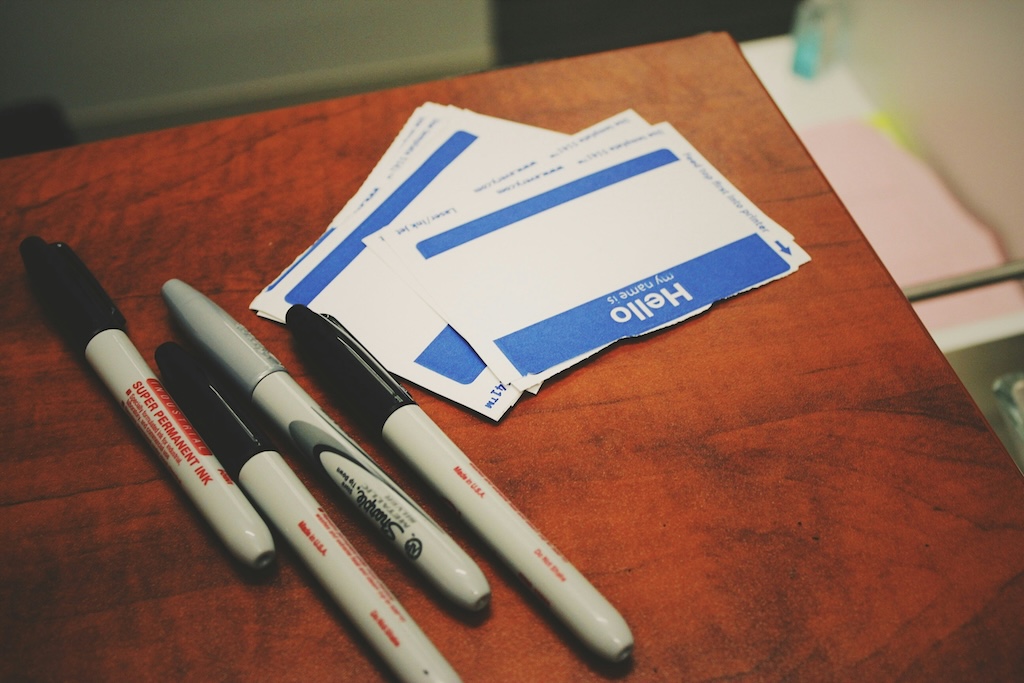
Deadnaming is when someone calls a transgender or nonbinary person by a name they no longer use, usually the name they were given at birth. This can happen by accident, out of habit, or on purpose to dismiss someone’s identity.
Whatever the reason, hearing a deadname can bring up a variety of feelings. Being called by the right name is a basic part of feeling safe, so it’s worth understanding what deadnaming is and how to respond to it.
Key Takeaways
- Deadnaming means using a name a trans or nonbinary person has stopped using, whether by mistake or on purpose.
- It can be hurtful even when the person saying it means no harm.
- Research links being able to use a chosen name to better mental health outcomes among transgender youth.
- Being called the wrong name or pronouns is the most common negative experience trans people report with healthcare providers, and about one in four avoid care out of fear of mistreatment.
- Chroma Wellness is a safe, affirming space for LGBTQIA+ individuals seeking support
What Does “Deadname” Actually Mean?
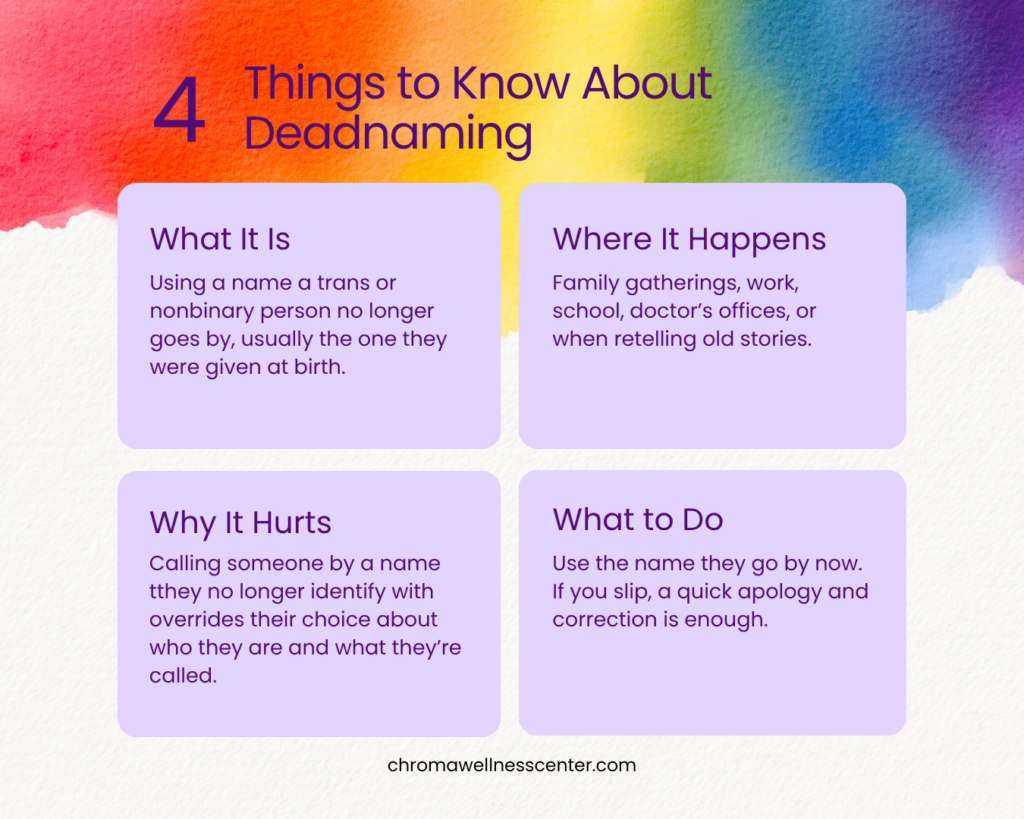
A deadname is a former name that a trans or nonbinary person no longer identifies with or uses, often as part of their transition. The “dead” part refers to the name being dead or no longer used.
The term itself is fairly new. Dictionaries date the earliest recorded uses to around 2010 [1]. While the term may be newer, people have been changing their names to reflect who they are for much longer than that.
Some people may use softer terms like “old name” or “birth name,” which are also perfectly acceptable.
Does Deadnaming Only Apply to Trans People?
In everyday use, yes. The term describes something that happens specifically to trans and nonbinary people, and it’s generally reserved for that experience [2].
However, philosopher Elek Lane points out that people reject names for many reasons, like an outgrown childhood nickname, a former married name, or Muhammad Ali’s rejection of “Cassius Clay,” and being called by a name you’ve rejected can sting in a similar way [2].
What sets deadnaming apart for trans individuals is that it may tie back to gender, risk outing them to others, or bring up a time before they could live openly [3].
Is Deadnaming Always Intentional?
No. A lot of deadnaming happens by accident, like a supportive parent slipping out of habit or an old friend who hasn’t heard about a name change.
Sometimes it is deliberate, though. Refusing to use someone’s name after they’ve shared it, or using their old name to make a point, sends a clear message that their identity isn’t being respected or taken seriously.
Intent matters for how a moment gets repaired, but it doesn’t take away the sting.
Lane argues that a deadname works like a taboo word, so hearing one can still produce a visceral jolt even when everyone knows the slip was an honest mistake [3].
How Does Deadnaming Affect Mental Health?
Deadnaming is one form of minority stress, which is the extra, ongoing stress people carry when parts of who they are aren’t accepted by the world around them [4]. One slip may pass quickly, but repeated deadnaming tends to build up.
Beyond the moment itself, deadnaming can:
- Out someone to people who didn’t know they’re trans
- Bring back painful memories from before transition
- Signal that a space or relationship isn’t safe
The reverse matters too. In one study, trans youth who could use their chosen name in more parts of their lives (home, school, work, and with friends) had fewer symptoms of depression and less suicidal thoughts [6].
If you’re in crisis, help is available now. These lines are free and open 24/7:
- 988 Suicide & Crisis Lifeline: Call or text 988, or chat at org.
- Trans Lifeline: Call 877-565-8860 for peer support from trans people.
- The Trevor Project: Call 1-866-488-7386 or text START to 678-678 for crisis support for LGBTQ+ young people under 25.
If you or someone else is in immediate danger, call 911 or go to your nearest emergency room.
How Does Deadnaming Show Up in Healthcare?
Healthcare can be one of the hardest places to be deadnamed. In the 2022 U.S. Transgender Survey, being called the wrong name or pronouns was the most common negative experience respondents had with providers, and about one in four avoided care they needed out of fear of mistreatment [7]. The same survey also found more trans people reporting respectful care than in years past.
Names often come up because the one on an ID or insurance card doesn’t match the one a person uses. In one first-person account, a trans man described being repeatedly deadnamed in an emergency department after an assault, and said it was retraumatizing. He contrasted that with a clinic that simply asked every patient at check-in how they’d like to be addressed [8].
If past experiences have made you hesitant to reach out, it’s okay to ask providers questions before you start.
What Should You Do If You Deadname Someone?
Keep it simple. A long apology can put the other person in the awkward spot of comforting you, so a quick correction usually works best.
A few things that can help:
- Correct yourself and keep going (“Sorry, I mean Jordan”).
- Avoid repeating the old name, even when telling a story about the past [2].
- Don’t ask for or share someone’s deadname.
- Follow their lead, because some people are fine with their old name in specific places, like on earlier published work [2].
What Should You Do If You Accidentally Use Someone’s Deadname?
Keep it simple. A long apology can put the other person in the awkward spot of comforting you, so a quick correction usually works best.
A few things that can help:
- Correct yourself and keep going (“Sorry, I mean Jordan”).
- Avoid repeating the old name, even when telling a story about the past [2].
- Don’t ask for or share someone’s deadname.
- Follow their lead, because some people are fine with their old name in specific places, like on earlier published work [2].
How To Cope With Being Deadnamed?
There’s no single right way to respond, and you don’t have to say or do anything if you don’t want to.
One thing research consistently points to is connection. Spending time with friends, chosen family, and community who use your name without hesitation can help buffer the effects of minority stress, including the stress of someone using your deadname [4][5].
When deadnaming is part of a bigger pattern of stress, rejection, or feeling unsafe, affirming mental health support can help you work through it without having to explain yourself first.

How Chroma Wellness Can Help
Chroma Wellness Center in Denver was built specifically for the LGBTQIA+ community, so your name and pronouns are respected from the very first call.
Our LGBTQIA+ Partial Hospitalization Program (PHP) and Intensive Outpatient Program (IOP) offer structured support for mental health, trauma, and substance use concerns, with gender-affirming mental health care and supportive LGBTQIA+ housing.
Whenever you’re ready, you can call our team at 720-410-5569 to talk through your options.
If you’re in crisis right now, call or text 988, reach Trans Lifeline at 877-565-8860, or contact The Trevor Project at 1-866-488-7386.
FAQs
What is an example of deadnaming?
A common example is a relative introducing a trans family member by their old name at a holiday gathering. It can also happen when a clinic calls out a legal name in a waiting room, or when someone uses a former name while telling a story about the past.
Why is it bad to deadname someone?
Using a name someone no longer identifies with overrides their right to decide what they’re called, and it can out them or bring up painful memories [2]. Over time, it can also wear on mental health and make spaces feel unsafe.
Is it rude to call someone by their deadname?
Yes. Once you know someone’s name, using the old one is disrespectful, though an honest slip followed by a quick correction is very different from refusing to use it.
What's the difference between deadnaming and misgendering?
Deadnaming means using someone’s old name, while misgendering means referring to them with the wrong gender, such as incorrect pronouns. They often happen together, but they aren’t the same thing.
Is it okay to ask someone what their deadname was?
Generally, no, it’s not polite to ask. If someone wants to share their old name, they will.
Sources
[1] Merriam-Webster. (n.d.). Deadname. In Merriam-Webster.com dictionary. (First known use dated to 2010; the Oxford English Dictionary likewise records its earliest evidence for the noun in 2010.)
[2] Lane, E. (2025). Deadnaming, taboo, and linguistic authority. Mind, 134(536), 1015–1039.
[3] Lane, E. (2025). The impact of deadnaming. The Philosophical Quarterly. Advance online publication.
[4] Meyer, I. H. (2003). Prejudice, social stress, and mental health in lesbian, gay, and bisexual populations: Conceptual issues and research evidence. Psychological Bulletin, 129(5), 674–697.
[5] Hendricks, M. L., & Testa, R. J. (2012). A conceptual framework for clinical work with transgender and gender nonconforming clients: An adaptation of the Minority Stress Model. Professional Psychology: Research and Practice, 43(5), 460–467.
[6] Russell, S. T., Pollitt, A. M., Li, G., & Grossman, A. H. (2018). Chosen name use is linked to reduced depressive symptoms, suicidal ideation, and suicidal behavior among transgender youth. Journal of Adolescent Health, 63(4), 503–505.
[7] Rastogi, A., Menard, L., Miller, G. H., Cole, W., Laurison, D., Caballero, J. R., Murano-Kinney, S., & Heng-Lehtinen, R. (2025, June). Health and wellbeing: A report of the 2022 U.S. Transgender Survey. Advocates for Transgender Equality.
[8] Watson, A. (as told to Laupacis, A.). (2023). The need to respect a person’s identity: Experiences of a transgender man. CMAJ, 195(44), E1522. (Humanities perspective; not peer reviewed.)
[9] Colorado General Assembly. (2025). HB25-1312: Legal protections for transgender individuals.